
Some of the world’s largest …
Large construction projects around the world have utilized significant amounts of concrete because of the material’s strength, durability, and versatility.
Here are four of these large and impressive construction projects involving concrete.
Three Gorges Dam, China …
Located on the Yangtze River, the Three Gorges Dam is the world’s largest concrete structure. It spans over 1.45 miles (2.3 kilometers) in length and stands 607 feet above sea level at its top. It was built to control flooding on the Yangtze River and provide hydro-electric power. It also provides fresh water to cities downstream as well as water for irrigation. The dam also includes a ship lift, taking vessels up to 3,000 tons 371 feet up and over the dam.
Construction started in 1994 and was completed in 2015. The project used 35.6 million cubic yards of concrete (mainly for the dam wall) as well as 463,000 tons of steel. About 134.2 million cubic yards of earth had to be removed as part of the construction process.

When the dam is full, the reservoir water level is 361 ft higher than the river below. The reservoir is about 410 miles long, covers 156,00 acres and contains some 51 billion cubic yards of water. The dam contains 32 main generators and in 2018 they provided 101.6 TWh of power.

While the dam project aimed at generating renewable hydroelectric energy is not devoid of controversy, it is essential to acknowledge its drawbacks. Approximately 1.24 million residents were compelled to relocate, and the reservoir has witnessed several substantial landslides, with certain instances involving the descent of up to 65,000 cubic yards of material into the reservoir. Despite China’s pursuit of sustainable energy solutions, these challenges underscore the unavoidable pitfalls that often accompany such ambitious undertakings.
Panama Canal Extension …
The completion of the Panama Canal expansion in 2016 marked a significant milestone, effectively doubling the canal’s capacity. This was achieved by adding a new traffic lane, accommodating a greater number of ships. Notably, the widened and deepened lanes, along with expanded locks, now allow passage for ships that are one and a half times larger than the previous maximum size permitted.
Initiated in 2007 and finalized in 2016, the project has proven its impact in the first 20 months of operation, facilitating the transit of 3,000 ships of the new, larger size through the canal.

The sheer scale of the construction effort is staggering, involving:
- Excavation of 91.7 million cubic yards
- Deployment of 318,952 tons of steel
- Utilization of 7.2 million cubic yards of concrete
- Contribution of more than 100 million work hours
Central to the project are the 16 colossal steel gates, manufactured in Italy and transported by sea over a seven-year period. Each gate, weighing an average of 3,306 tons, efficiently opens and closes the water chambers in a mere five minutes. These chambers function like colossal lifts, enabling ships to traverse the 88-foot elevation difference between the two oceans and the man-made Lake Gatún.

To ensure a service life of 100 years, a new concrete grade (DYNAMON XP2 EVOLUTION 1) was specially developed to withstand the unique challenges posed by contact with the Pacific and Atlantic oceans.
The ambitious venture incurred an estimated cost of $5.5 billion, with a projected annual revenue of around $6 billion anticipated by 2025. The Panama Canal expansion stands as a testament to engineering prowess and strategic vision on a global scale.
Burdj Khalifa, UAE …
The Burj Khalifa in Dubai stands as the world’s tallest skyscraper, soaring to a height of 2,722 feet. Its construction, spanning from 2004 to 2010, was a monumental feat, with a substantial reliance on concrete for its massive foundation and central core.
With 160 habitable levels ascending over half a mile into the sky, the Burj Khalifa offers a breathtaking vantage point. Notably, on its uppermost floors, the sunset occurs three minutes later than at ground level, and the exterior temperature is a chilling 11°F cooler than the base.

The construction statistics are staggering – 431,600 cubic yards of concrete, 60,627 US tons of steel rebar, and a staggering 22 million man-hours were invested. The foundation alone required over 58,900 cubic yards of concrete, weighing in at more than 121,254 US tons. This foundational strength is achieved through 192 piles, each 5 feet in diameter, buried at a depth exceeding 164 feet and spanning a length of 141 feet.
The concrete used in construction had to withstand immense pressure and extreme Persian Gulf temperatures, reaching up to 122°F. To address this challenge, strategic measures were taken: concrete was poured at night during the summer, incorporating ice into the mix. This nighttime approach allowed for cooler air and higher humidity, ensuring a more even curing process that minimized the risk of premature setting and cracking.

The tower itself comprises 350,000 cubic yards of concrete, 42,990 US tons of reinforced steel, 1.1 million square feet of glass, and 166,800 square feet of embossed stainless steel. Beyond its impressive structural components, the Burj Khalifa is a versatile marvel, housing offices, restaurants, apartments, hotels, swimming pools, tourist observation floors, and nightclubs. The seamless flow within the tower is facilitated by 57 elevators, transporting occupants at a brisk 33 feet per second.
Hoover Dam Bypass, USA …
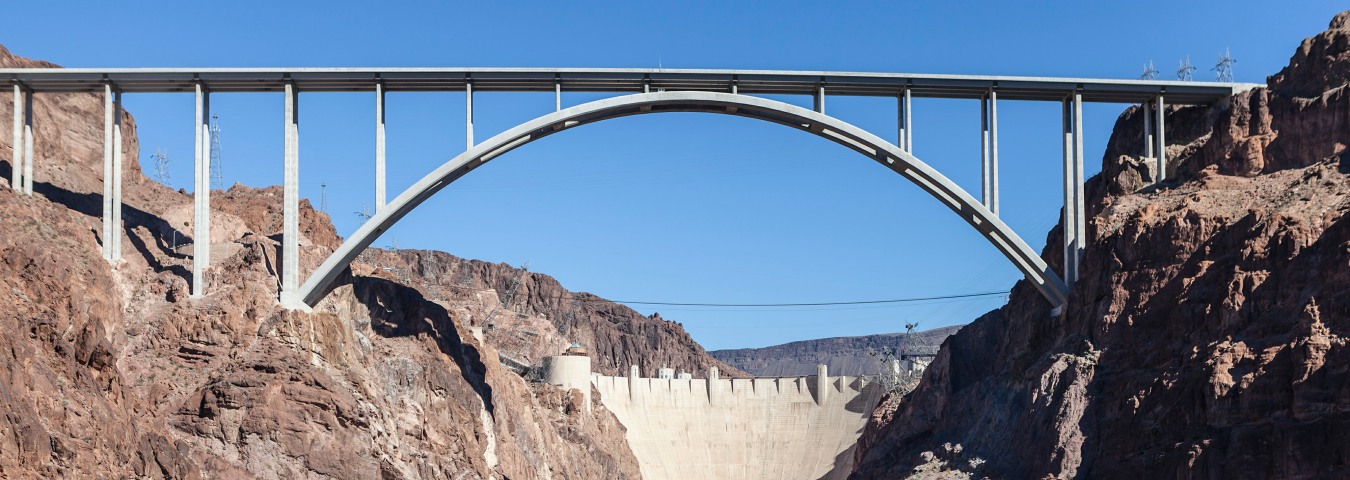
The Hoover Dam Bypass, known as the Mike O’Callaghan-Pat Tillman Memorial Bridge, spans the Colorado River, serving as a necessary detour for traffic around the Hoover Dam, which had become inadequate for the high volumes on US Route 93.
Positioned 1,500 feet downstream from the dam, the bridge stands 890 feet above the river. The project, including both the bridge and its approaches, commenced in 2003, with bridge construction beginning in 2005. Completed in 2010, the entire project stayed within its $240 million budget.
The bridge stretches 1,900 feet with a total span of 1,060 feet, featuring a four-lane roadway positioned 900 feet above the Colorado River. Remarkably, it is the first concrete-and-steel composite arch bridge in the United States, boasting the widest concrete arch in the Western Hemisphere.

Connected by steel struts, the twin arch ribs, made up of 53 pieces per arch, were constructed concurrently from both sides. A setback occurred in 2006 when construction crane cable systems collapsed in high winds, delaying the project by two years.
Despite the challenges of working 900 feet above the river, the arches met at the center in August 2009 with a gap less than 3/8 of an inch, a remarkable achievement. The gap was filled with reinforced concrete, allowing for the removal of temporary cable stays, rendering the arch self-supporting.

By December, all eight vertical piers on the arch were set and capped, and the first two of thirty-six 45-ton steel girders were in place. By mid-April 2010, all girders were set, enabling construction crews to walk across the structure. The bridge deck was paved by July, and as the project approached completion, high-line cranes were removed.
The entire bypass, including the bridge, opened to traffic on October 19, 2010. In 2004, the bridge was officially named the Mike O’Callaghan–Pat Tillman Memorial Bridge, honoring Korean War veteran Mike Callaghan and former NFL player Pat Tillman, who tragically died in Afghanistan in 2004.
Conclusion …
These monumental construction projects exemplify the versatility and significance of concrete in building infrastructure and iconic structures worldwide, showcasing its ability to provide stability, strength, and longevity in various applications.